
Five years after demonetisation, which sought to curb black money and reduce cash circulation in the economy, 70 per cent of respondents said they paid a large component of the total payment towards a real estate transaction in cash. About 16 per cent said they paid over half the amount in cash, observes Shyamal Majumdar.

With an epic battle of billionaires for supremacy in one of the world's most prolific markets and a pandemic-propelled surge in online shopping in the background, India's nearly trillion-dollar retail market is hoping to touch 85 per cent of the pre-COVID business in the first half of the New Year. In a year when the COVID-19 carnage ripped apart the retail business, circa 2020 will best go down for the unravelling of the war between Jeff Bezos, the world's wealthiest man, and richest Indian Mukesh Ambani for pre-eminence in the booming market that is estimated to reach $1.3 trillion by 2025. It all started with Ambani's Reliance Industries agreeing in August to buy assets of the nation's second-largest retailer for Rs 24,713 crore, just a year after Bezos' Amazon purchased an indirect stake in the indebted Future Retail.

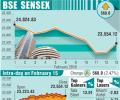
Bajaj Finserv was the top loser in the Sensex pack, shedding around 3 per cent, followed by Bajaj Auto, Bajaj Finance, L&T, Asian Paints, Dr Reddy's, ICICI Bank, HDFC Bank and RIL. NSE Nifty finished 101.45 points down at 14,929.50.

Among the key concerns of the Street is market share losses in growth segments, led by higher competitive pressures.

'Farmers will block rail tracks in various places. Markets and transport services will be closed during 'Bharat Bandh'

The art of making Ittar (scent) is perhaps as old as civilisation.
After consumer price index jumped the 6.3-per cent mark in May and wholesale inflation set a record of 12.94 per cent, house economists at Swiss brokerage UBS Securities have warned that the country is facing more upside risks on the inflation front that is set to averaging at 5 per cent for the year. Rising prices of edible oils and protein rich items pushed retail inflation to a six-month high of 6.3 per cent in May, breaching the comfort level of the Reserve Bank and thus rendering reduction in interest rates a difficult proposition in the near term. Led by petrol price, that has crossed the Rs 100-mark in many states, wholesale inflation too accelerated to a record 12.94 per cent in May. While crude oil has crossed $70 a barrel on account of rising prices of crude oil and manufactured goods due to spike in commodities, and the low base of last year due to the lockdown.
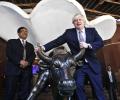
In recent past, midcap stocks have performed well, say experts.

Foreign banks set the template in consumer banking in its infancy, but have almost vacated this booming space.
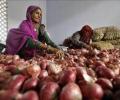
Prithviraj Chavan helping out Delhi's government tide over high onion prices has not gone down well in his home state of Maharashtra, says Neeta Kolhatkar.
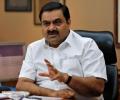
Adani Power expects to reduce its annual interest cost to Rs 1,900 crore, from the current Rs 3,800 crore through low cost funding.

Billionaire Mukesh Ambani-run Reliance Industries Ltd's retail arm on Thursday raised Rs 9,555 crore from Public Investment Fund (PIF) of Saudi Arabia, taking total fundraise in the last two months to Rs 47,265 crore. PIF will take a 2.04 per cent stake in Reliance Retail Ventures Ltd (RRVL), the Indian firm said in a statement. The investment values RRVL, the retail arm of Reliance Industries Ltd, at a pre-money equity value of Rs 4.587 lakh crore.

Tata Motors has halved the volume outlook for its UK subsidiary Jaguar Land Rover Automotive (JLR) and warned of lower earnings as it sees the semiconductor shortage deepening in the September quarter of the current financial year, according to a notification issued by the company to the stock exchanges on Tuesday. The announcement caught investors unawares. They were hoping for a quicker recovery. Tata Motors' stock tanked 13 per cent (on July 6) from the day's high of Rs 358.10 and hit the lower circuit (Rs 311.45) in intra-day trades.

Abu Dhabi-based sovereign wealth fund Mubadala Investment Co will invest Rs 6,247.5 crore to buy a 1.4 per cent stake in Reliance Industries Ltd's retail arm -- the billionaire Mukesh Ambani-led firm's third such deal in less than two days.
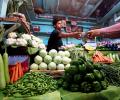
This could be the reason why Prime Minister Narendra Modi mentioned tomato, onion, and potato as his government's 'TOP' priority, in an election rally on February 5 in poll-bound Karnataka.

If the CBDCs don't offer interest, why will people shift from cash to CBDCs?, asks Tamal Bandyopadhyay.

Bajaj Auto was the top laggard in the Sensex pack, tumbling around 6 per cent, followed by M&M, Reliance Industries (RIL), Tata Steel, Tech Mahindra, SBI, Axis Bank and ICICI Bank. NSE Nifty tumbled 162.60 points or 1.36 per cent to 11,767.75.

Medicines, including antibiotics, contraceptives and anti-diabetic drugs, were found to be out of stock at various places around Delhi.

E-commerce firms Amazon, Flipkart, and others are expected to witness blockbuster festival season sales of around $9 billion this year, surpassing pre-pandemic sales of $5 billion in 2019. The pandemic has accelerated the shift to e-commerce, with more consumers shopping online at a higher frequency than last year, observed analysts. This year's festival sales (gross merchandise value or GMV) are expected to grow 30 per cent year-on-year (YoY) to $4.8 billion during the first week of the season and potentially clock over $9-billion GMV during the whole festival month, revealed consulting firm RedSeer's e-commerce festival season report.

'Coronavirus has occasioned us to see how copious Modi's mojo bag is,' says Shreekant Sambrani.
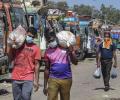
It is likely the government will divide the country into different zones during the proposed extended period of lockdown and might permit a few services to function in safe zones.

Passenger vehicle wholesales in India slipped to a 10-year low in the April-December this fiscal, and the industry will have to work hard to regain better volumes and business health, industry body SIAM said on Thursday.

India's macroeconomic situation is certainly better than what it was a year ago, eminent economist Pinaki Chakraborty said on Monday, while expressing hope that the country will be back on the path of economic growth if there is no major third wave of the COVID-19 pandemic. In an interview with PTI, Chakraborty, who is the director of the National Institute of Public Finance and Policy (NIPFP), said that inflation may remain at an elevated level as there was a significant fiscal and monetary expansion in the last 18 months. "The current macroeconomic situation is certainly much better than what it was one year back. We are seeing recovery in most sectors," he said. Chakraborty noted that COVID-19 vaccination has been going on at a very fast rate in India.

Amazon on Sunday won an interim award against its partner Future group selling retail business to Reliance Industries for Rs 24,713 crore after a Singapore-based single judge arbitration panel put the deal on hold. Amazon had dragged Future to arbitration after the Kishore Biyani group firm had agreed to sell businesses to billionaire Mukesh Ambani's Reliance.
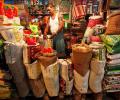
Despite the failure of most e-commerce players to meet orders through the first week of the lockdown, there has been no serious crisis, thanks to supplies from 11 million small kirana and mom-and-pop stores across the country with the support of over 300,000 distributors and wholesalers.

Besides, Toyota and MG Motor also reported nil sales as they suspended operations even before the imposition of lockdown on March 25 to check the spread of coronavirus. In two-wheeler segment, niche bike maker Royal Enfield said it had zero sales in the domestic market but exported a total of 91 units last month.

A massive fire engulfed a private nursing home for senior citizens in central China, killing at least 38 residents who were charred beyond recognition and prompting authorities to order nationwide safety checks of public buildings.
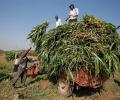
India achieved record foodgrains production this year but the withdrawal of three agri-reform laws and spike in cooking oil prices cast a shadow on the country's resilient agriculture sector that is on course for better harvest in 2022 despite pandemic blues. While soaring production of foodgrains that also helped the government provide free additional rations for COVID-hit poor families for many months together came as a relief, the passing year will be remembered for the long drawn farmers' protest at Delhi borders against the three laws and subsequent repeal of the legislations. The Indian agriculture sector, which was among the few segments that remained robust amid the pandemic gales, is expected to register a growth rate of 3.5 per cent in the current financial year ending March 2022.
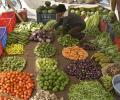
In most cases, however, retail consumers are paying higher prices in the absence of direct procurement from aggregator or farmers.

Until a sizeable number of the population are vaccinated, Covid-appropriate behaviour needs to be followed aggressively, he said and stressed on the need for stricter surveillance and area-specific lockdowns in case of a significant surge.
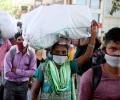
The government on Monday ruled out the possibility of free food-grains distribution to migrants saying there is no panic situation and no complete national lockdown unlike last year.

Bulk of the medicine sales in the $22-24 billion domestic pharma market happens through offline retail chemists. With the entry of online pharmacies, this space has started to witness a shake-up. Sample this: Dawaa Dost, a Rajasthan based digital health start-up, generates medicine orders from 'kirana' stores and women self-help groups (SHGs) that operate in villages, and then service these orders through its affiliated network of pharmacies. Biddano, another health-tech start-up, has a platform that acts as an aggregator for neighbourhood chemist shops.

Tech Mahindra was the top laggard in the Sensex pack, cracking over 5 per cent, followed by Infosys, HDFC, IndusInd Bank, Reliance Industries and NTPC. On the other hand, Hero MotoCorp, L&T, Maruti, UltraTech Cement and Sun Pharma led the gainers' chart.

NSE also said it will not charge any transaction fees on trade in interest rate futures for one more year.
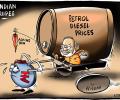
The Union government has collected Rs 94,181 crore through levy of excise duty on petrol and diesel in the first three months of the current fiscal on the back of a record tax on fuel that yielded 88 per cent higher revenue the previous financial year, the Lok Sabha was informed on Monday. Excise duty on petrol was hiked from Rs 19.98 per litre to Rs 32.9 last year to recoup gain arising from international oil prices plunging to multi-year low as pandemic gulped demand. The same on diesel was raised to Rs 31.8 from Rs 15.83 a litre, according to a written reply by Minister of State for Petroleum and Natural Gas Rameswar Teli in the Lok Sabha. This led to excise collections on petrol and diesel jumping to Rs 3.35 lakh crore in 2020-21 (April 2020 to March 2021), from Rs 1.78 lakh crore a year back, he said.

Members of the G-23, who had shown courage to point out the flaws in the party's functioning, have allowed themselves to be co-opted by the Family to go through the motions of a post-mortem, notes Virendra Kapoor.
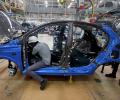
While sales of compact cars, including models such as Swift, Celerio, Ignis, Baleno and Dzire declined, sales of utility vehicles, including Vitara Brezza, S-Cross and Ertiga, increased 26.3 per cent to 19,177 units as compared to 15,178 in the year-ago month.

Hitting GDP growth of more than six per cent will require substantial foreign direct investment, especially if household savings largely continue to remain locked.

Around two dozen flour mills with its maida supply dedicated to Nestle have stopped production.
